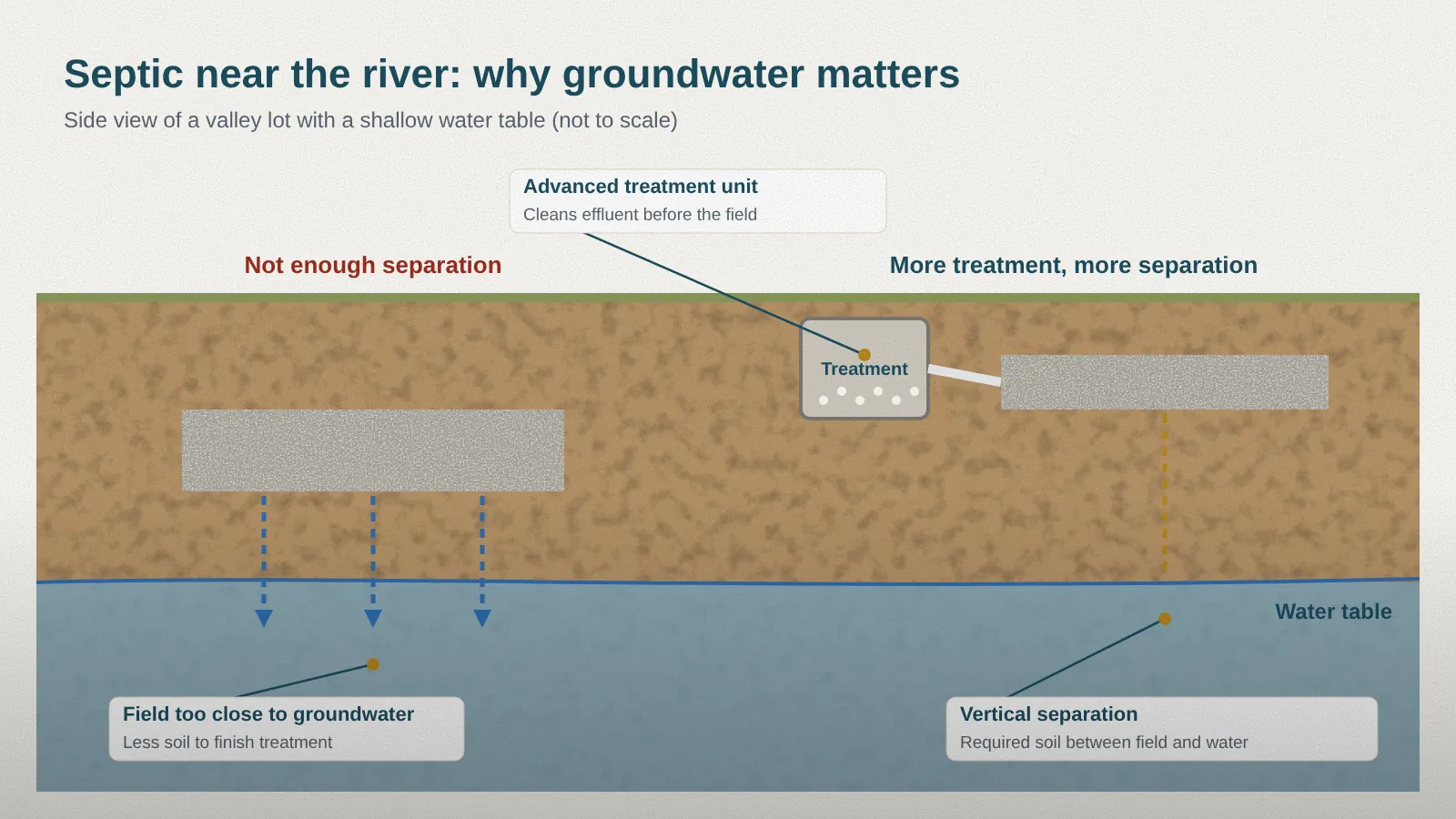
Separation is the key
Most treatment in a conventional system happens in the unsaturated soil below the field. If groundwater is too close, effluent reaches it before it's fully treated. That's why state rules require a minimum separation — and why lots near the river often need different designs.
Seasonal highs
Groundwater near the Rio Grande rises and falls with river flows and irrigation. A site evaluation looks for signs of the seasonal high, not just the level on one day.
Design responses
- Shallower fields
- Advanced treatment before the field
- Pressure dosing for even distribution
- Choosing the highest part of the lot
Tanks in wet ground
An empty tank in saturated soil can float. Tanks are installed and, when needed, anchored to prevent that — especially when they're pumped.
Common questions
How do I find my groundwater depth?
A site evaluation with test pits.
Is shallow groundwater common in Corrales?
It can be, particularly closer to the river.
Can I still have a conventional system?
If there's enough separation, yes.